Spherical Harmonics based Structure from Motion without Correspondences

The aim of this project is to apply the structure from motion (SFM) algorithm by Makadia and Daniilidis to large scale datasets. The algorithm works by exploiting the fact that a brute force approach to solving the correspondence problem for dense SFM is equivalent to a computing correlation between two images, one of them being transformed by a rigid motion. The optimization for this rigid motion between the cameras, which would be intractable if performed naively, is tractable if performed in Fourier space.
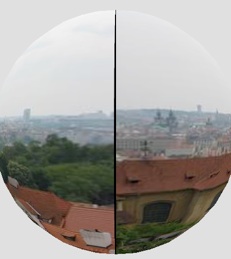
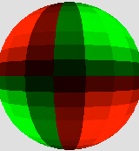
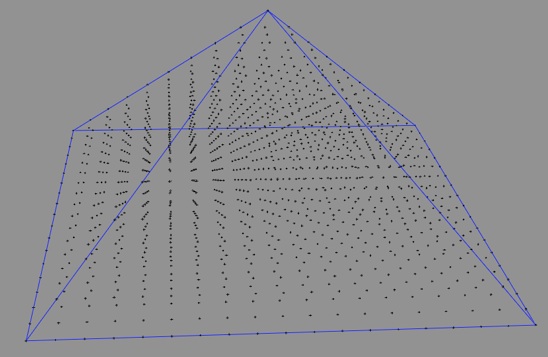
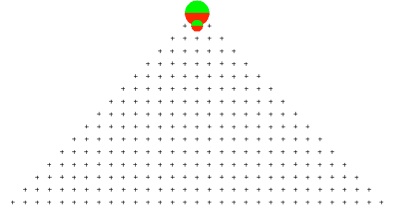
In particular, for spherical images, the Fourier space consists harmonics on the double sphere. The coefficients of harmonics for a single sphere form a triangle as they are indexed by two numbers. An image wrapped on a sphere and sample harmonics are shown in the Figure above. A pure rotation between images can be recovered by computing the spherical harmonics of the two images and performing an outer product. This yields a pyramid of coefficients of a function on the rotation space SO(3). The maximum of this function (obtained using an inverse Fourier transform in SO(3) space) gives the required rotation. The pyramid of SO(3) Fourier coefficients is shown below.
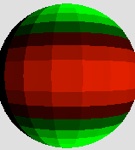
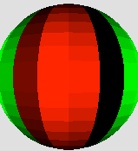
Harmonics for order l=3, and degree m=0,1,2